The health and welfare of mankind
A company pursuing the highest value
Aspiring for Better Tomorrow and Healthcare


Importance of Containers for Infusion
The basic infusion was already developed and completed long ago to have been used until now. Containers for such drug solution have been evolved continuously. In this sense, the history of modern infusion is closely related to the evolution process of containers. It is not too much to say that the development history of infusion in Korea is that of such containers.
The container for infusion is the one to contain drug solution administered directly to the vein of the human body. During the several years of storage period for the product, the inner part of the container must be safe which may contact directly with the drug solution to prevent an effect on the drug solution, so that it is a special container required of a high quality such as aseptic condition different from general glass containers. Therefore, each country has regulated and controlled the strict quality standard for such containers for infusion.
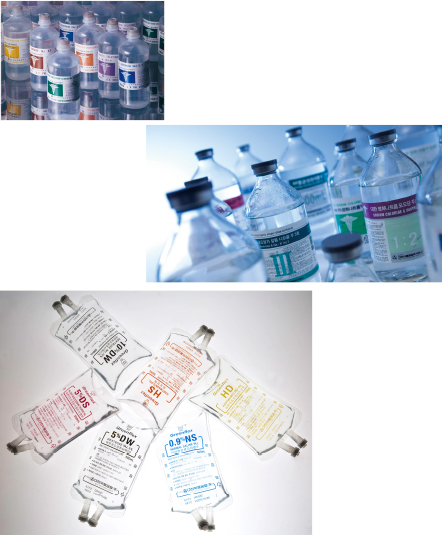
Classification of Containers for Infusion
Classification by containers' materials
: Glass (glassblower) container, plastic container (PVC or non-PVC)
Classification by containers' shapes
: Container with bottle shape & container with bag shape
Traditionally, containers for infusion are glass containers, which have been used for longest years until now since the first development of glass containers for infusion. However, due to the concerns of damage from handling and relative heavy weight, there had been user inconveniences from patients. Accordingly, the container for infusion in plastic material has been developed to improve such inconvenience.
The plastics either used for the plastic container for infusion or used currently are not largely being used in Korea. They can be classified into a container with PVC material that was once the representative material and a currently used container with non-PVC material.
We have been using the container in non-PVC material only because of the controversy of the hazardous plasticizer with PVC material. The non-PVC material naturally means the material which is not PVC. There are multi-layered films in the container where the surface that contacts with the solution is made of PP or PE, and the mid and outer layers of separate materials.
Besides, containers for special infusion have been developed and used such as a multi-chamber bag used for TPN or a plastic container for amino acid infusion.

- 3, Seonyu-ro 45-gil, Yeongdeungpo-gu, Seoul, Republic of Korea 07209
- CEO SungYoung Lee
- Corporate Registration Number 107-81-34737
- Tel +82-2-2678-3911
- COPYRIGHT(C) 2019 DAI HAN PHARM CO.,LTD. ALL RIGHT RESERVED